Whoa, weighty topic huh?
This is in response to a post on John August's blog, reporting about a WGA panel addressing the state of screenwriting and tips for screenwriters.
It's not pretty. Even for an unashamedly commercial writer who'd kill to write Alien vs. Predator vs. Transformers 2, the present and future are not looking great.
More than ever, the marketing department determines which scripts get greenlighted. There's less money for production in general, so only the most commercial, most pre-sold (as in, based on a pre-existing property) projects get off the ground.
If the big boys (the majors) are tightening their belts like mad, where does that leave everyone else... you know, the alternatives like the supposed "indie scene"?
Okay, let me say it. I hope I'm wrong.
The American film industry is slowly collapsing.
Screenwriters are reporting that the market has gotten even more cutthroat in the last few years, but film quality has not noticeably improved. Movie attendance is up so far, but DVD is down and ticket prices are rising faster than the rate of inflation. Movies are more expensive than ever to make.
It's sort of an entertainment stagflation right now.
I believe that the industry is about where it was in 1964, when it was becoming clearer that Hollywood was leaving its transition stage (1948-1967) and about to blossom into its magnificent Silver Age, the fabled time of the American auteur, the time of 2001, M*A*S*H, The Godfather, Jaws, Star Wars...
But I'm having trouble seeing a New Silver age coming up.
The reason folks like Coppola and Spielberg got esteemed positions in the first place was because the powers-that-be hadn't a clue what the youth market wanted-- so they tried anything and everything to put bums in seats.
Allegedly the executives who got pitched Harold and Maude (1971) couldn't understand what the movie was about, let alone why anyone would want to see it. But with the suggestion of a hip soundtrack, it got the greenlight without reservations.
Marketing has evolved a lot since 1971, and now thanks to Facebook and Twitter a square old executive can (supposedly) figure out exactly what the kiddie's want, and then envision a movie with the intent of exploiting the latest "It".
Not a particuarly creative environment, huh?
Another difference is technology: enterprising young producers are turning to webcasts to deliver new media products. Of course, movies are designed to be projected on a screen [in film] in a dark room with other [attentive] people-- but this concept hasn't sat well with Generation Y and beyond, if the amount of talking and texting in multiplexes is a reliable indicator.
Okay, you say. So mass audiences are migrating away from the traditional notions of cinema. Can't it just evolve like live theater did after the "talkies": a smaller, specialized art form appealing to certain demographics?
My thought (and I hope this isn't the case) is no.
One point is economic. Films cost a freakin' lot of money. They take a freakin' lot of people to make happen. They take a freakin' long time to put together. Decreased interest and decreased capital availble means... decreased movies.
The other point is interest itself. I have been told that my generation is the most visually sophisticated ever.
But we also have as more entertainment options than ever before. And oddly enough, I don't think our generation's taste is any more sophisticated than the past.
Decades ago, there used to be campus film societies where geeks would sit around and talk about Ozu and John Ford and watch 16mm prints while the film-nerdiness would exude all over the screening room.
Some of that still exists online at IMDB and elsewhere. But as my Independent Cinema professor pointed out, that sort of subculture that fostered the nascent careers of the Movie Brats dried up with the introduction of VHS, and has gotten even more eviscerated since.
Few people of my generation want to be the next Welles, like Bogdonavich did. Or the next Lean, like Spielberg did.
I shudder to think of when wanting to be even the next Zack Snyder (300, Watchmen) is considered a statement of one's artistic integrity.
Will the movies die? I don't think so. I think we're going to see a schism between extremely professional "slick" films (in Digital IMAX 3-D and so forth) and extremely lo-budget "grunge" films made for $20. Hopefully the two can co-exist for a while.
But I'd hate to lose the middle ground for good.

2.26.2009
Project Update redux
Duh, I forgot the one I just completed, my experimental "autobiography" video.
Here is my rant: I think the idea of an autobiography is impossible. Even if you accept that every bio and autobio is going to be painfully subjective, I feel that the nature of the autobio is so hopelessly subjective that it's more fantasy than fact.
Not that it's impossible to know one's self. Or that it's impossible to represent one's self in any context. But as your conscious awareness is so selective to begin with, autobiographies are like the literary equivalent of Fantasy Football: full of "best-of"s and hypothetical renderings pretending to be the real deal.
If I had to write a straight up autobio, I would claim to be raised by natives in Papua New Guinea, before stowing away on a cargo ship and ending up at a migrant worker camp in Texas. Because that's a far more interesting story to me than my actual past life.
So I decided to make a "subconscious video diary", a somewhat surrealist account of an average day in my life. I think it works for the most part: lots of sound design, lots of manipulated footage, lots of bizarre edits, lots of snatches of music.
Some parts work, some don't. I think my professor won't find it autobiographical enough-- I'll do my best to defend.
I'll keep you updated on how it goes.
Here is my rant: I think the idea of an autobiography is impossible. Even if you accept that every bio and autobio is going to be painfully subjective, I feel that the nature of the autobio is so hopelessly subjective that it's more fantasy than fact.
Not that it's impossible to know one's self. Or that it's impossible to represent one's self in any context. But as your conscious awareness is so selective to begin with, autobiographies are like the literary equivalent of Fantasy Football: full of "best-of"s and hypothetical renderings pretending to be the real deal.
If I had to write a straight up autobio, I would claim to be raised by natives in Papua New Guinea, before stowing away on a cargo ship and ending up at a migrant worker camp in Texas. Because that's a far more interesting story to me than my actual past life.
So I decided to make a "subconscious video diary", a somewhat surrealist account of an average day in my life. I think it works for the most part: lots of sound design, lots of manipulated footage, lots of bizarre edits, lots of snatches of music.
Some parts work, some don't. I think my professor won't find it autobiographical enough-- I'll do my best to defend.
I'll keep you updated on how it goes.
Project Updates
A personal log of what I'm working on right now:
I'm shooting my "perfect scene" (from Punch Drunk Love) sometime this weekend, reportedly. We have an actor more or less set for the dramatic Adam Sandler role. I'll likely play the Dentist, which is cool for me. I get a kick out of playing absurdly deadpan. I guess that's my "stage persona".
I pitched my final project for Narrative. Right now it's called Dysart Revisited, more details will follow as I reify things [I love that word!] and start working on pre-production. My professor really seemed to like it; he referred to an author I hadn't heard of, and I felt kinda stupid that I didn't who that was. It's not like I have to know everything, but at least I should be aware of similar styles of writing...
It comes down to father vs. son in a dying Southern town, stylistically Jim Jarmusch meets Terrence Malick. (Which I should write a post about one of these days.)
Details to follow...
And I'm working on my old feature-length again. I haven't thought about it since last August, and I don't think I've written of a word of it since December 2007. I totally revamped it, but I won't spill any beans. Yet.
Though I will say that the project has been constantly evolving since I first envisioned it in April 2004. Yes, that long ago.
In fact, there's only one common element through all the drafts, and even that has significantly diminished in importance over time. (Yeah, not even the same characters or types of plot.) It's like generations worth of organisms.
Anyway.
I'm shooting my "perfect scene" (from Punch Drunk Love) sometime this weekend, reportedly. We have an actor more or less set for the dramatic Adam Sandler role. I'll likely play the Dentist, which is cool for me. I get a kick out of playing absurdly deadpan. I guess that's my "stage persona".
I pitched my final project for Narrative. Right now it's called Dysart Revisited, more details will follow as I reify things [I love that word!] and start working on pre-production. My professor really seemed to like it; he referred to an author I hadn't heard of, and I felt kinda stupid that I didn't who that was. It's not like I have to know everything, but at least I should be aware of similar styles of writing...
It comes down to father vs. son in a dying Southern town, stylistically Jim Jarmusch meets Terrence Malick. (Which I should write a post about one of these days.)
Details to follow...
And I'm working on my old feature-length again. I haven't thought about it since last August, and I don't think I've written of a word of it since December 2007. I totally revamped it, but I won't spill any beans. Yet.
Though I will say that the project has been constantly evolving since I first envisioned it in April 2004. Yes, that long ago.
In fact, there's only one common element through all the drafts, and even that has significantly diminished in importance over time. (Yeah, not even the same characters or types of plot.) It's like generations worth of organisms.
Anyway.
2.24.2009
Zen And The Art Of De[con]struction
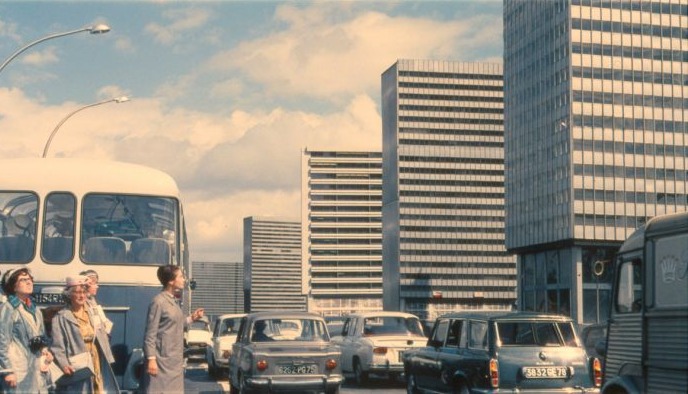
Movies Worth Watching: Playtime (1967)
Like the previously profiled Brewster McCloud (1970), Playtime is another title with a long history of unavailability. The good news is that the Criterion Collection offers a beautiful DVD edition that's worth every dollar. The bad news is the tragic story of its production.
In the 1950s, French comedian/auteur Jacques Tati was riding high on critical and commercial success, winning Best Foreign Film Oscars and entertaining Europe with his satirical silent-film style of comedy. (His influence is especially felt in Monty Python and Rowan Atkinson's Mr. Bean character.)
Therefore, he was able to get funding for his dream project: a multicharacter comic exploration of a modern city, playing at an epic length in 70mm. Being the perfectionist he was, no existing city fit his specifications, forcing him to build a city in the French countryside.
Although not fully to scale, this set (called Tativille) had actual inhabitable buildings with water and electricity, city streets, traffic lights, freeways, you name it.
And from there things got bad. Although production started in 1962 (I think), constant problems and Tati's snail's pace dragged the film out until 1967. By then, Tati's big budget and observational style seemed quaint up against the likes of the French New Wave. Critics panned Playtime, and it flopped pathetically.
The outrageous investment Tati had put into the film (including his personal savings) caused him to lose his house, property, and the rights to Playtime and all his other films. To add insult to injury, Tativille (which was intended to become a film school after production ended) was repossessed and torn down.
By the time it made it to America, the film was in a heavily butchered state that barely reflected what Tati intended.
But over the decades Playtime's mystique grew and it developed a cult following. In the 90s, Tati's family was able to put together a restoration that combines all the remaining footage from the original cut, which is what is available today.
So what makes Playtime more than an odd footnote in film history?
For one thing, it plays like no other film you've ever seen.
There is not a single close up. Heck, anything closer than a long wide shot is a rarity. There is also an almost total lack of dialogue. There are voices on the soundtrack, but they are either about trivial things like hotel room numbers, or in languages you don't understand.
There is a story, but there is no "plot". One sequence just follows another, just like a person would explore a city in real life.
A group of American tourists arrive in "Paris". The airport is so bland that it is indistinguishable from an office building or a hospital. The tourists get stuck in traffic on the freeway. An old man, M. Hulot (Tati himself) tries all morning to meet with his banker. He gets shuffled from one waiting room to another. Meanwhile the tourists visit an expo of tacky and useless products.
Everything in the first half of the film suggests that we have entered Hell. Everything about this environment is so impersonal, so calculated, and so bereft of vitality... but so familiar. This is our globablized world.
But something magical is going on. A "hip" restaraunt is trying to prepare itself for its grand opening while still under construction. The human element keeps getting in the way-- the restaurant would run fine if it weren't for the people. Eventually the tourists and Hulot end up there accidentally... and the place literally falls apart, bit by bit.
As people's mistakes "ruin" the "perfect" environment, the customers open up, become more relaxed, friendlier. They start making their own fun in the surroundings, instead of having entertainment fed to them by a higher economic power.
By dawn, the city has transformed. What was once Hell is now Heaven, where joyful sights and amusing stories are everywhere.
The secret is paying attention.
That's what Playtime is about: attention. The odd formal properties of the film force the audience to pay extreme attention if they want to understand anything. We are so used to the predigested formula that when we encounter something this radical, we revolt.
But maybe we have to break ourselves out of that mold. Maybe that's how we should see the world.
For as long as there is a place with humans, there are stories. There are emotions. There are little jewels of behavior. You just have to... pay attention to what's happening.
And with that in mind, Tati suggests, anytime becomes Playtime.
"From near to far, from here to there: funny things are everywhere." - Dr. Seuss
2.21.2009
Write and Wrong
Recently I've come to the conclusion that I'm a writer at heart.
I've actually known this for a quite a while, so it's not exactly a surprise. But by concluding that it has moved from the realm of possibility to fact.
What do I mean?
I've been writing things for as long I can remember. I attempted writing down stories before I had a good grasp of the form of the alphabet-- that's how long.
Some people work to develop their fiction writing muscles with conscious ambition, to improve their self-expression and creativity. Personally, I can't help it: I've had one writing project or another going continuously since 7th grade.
At some point, I assumed, I'd just "get over it" and settle down with a real goal for an occupation. I guess I thought I'd say "oh snap!" and suddenly realize that Public Health was where it was at. Or something.
My first major in college was Rhetoric. That was like, inverse writing. Whoa. Understanding how communication works. I loved it, and I still love it.
But it was just as impractical as majoring in Creative Writing, as Rhetoric tends to be a gateway for either marketing or PR. Around this time last year I realized that I have little interest for either.
So where did that leave me? Media.
Working on a film and at a television studio gave me a great amount of joy. I've always been attracted to the media, and the thought of making it happen always seemed to be too good to be true, like there was something standing in my way.
Turned out there wasn't.
When I directed my first little "serious" short, I felt the thrill of composing the visual presentation and working with the actors. It can be a pain, but in the end it's exhilarating.
But my stumbling block is that I've never been one to play with the toys for the toy's sake. I'm probably the last person on earth to get excited about a new piece of tech. I'm interested in things that can serve my creative needs.
So I'm not the dude who gets a thrill from setting up the dolly, or chatting about the latest piece of equipment.
I'm the dude who wants to sit down with the actors and chat about their characters. I'm the dude who goes off by himself and thinks, "what is the best way to show this?" then presents my vision to the DP, who figures out the nitty-gritty.
Turns out the former set of skills is more highly prized by the industry than the latter. Why? Because there can only be so many "creative" leads at one given time.
Most of the work has to be done by the creative grunts, the ones who know all the secrets of Final Cut and After Effects.
That's what I mean by saying that I'm a writer at heart. I want to create the story, not create the creation of the story.
I do have anxieties that my own technical skills are not "enough" in the cutthroat industry. I could even be right: I certainly have no interest in becoming a DP.
I quote from an interview with superb writer/director Joss Whedon, who somehow managed to not compromise artistic success with commercial success:
Heaven's Gate is an unbelievably gorgeous movie. It is also physically painful to watch.
Cassavettes didn't give a flip about how his movies looked: which makes them an ordeal to sit through when you're accustomed to Hollywood-ish aesthetics. A better model is my arch-hero Altman, who made movies that looked good, but wouldn't let the requirements of "correctness" diminish what he was trying to accomplish.
In conclusion: My goal, then is to do my best (with the help of others) to do as much of the "creation" as possible. And hope for the best.
I've actually known this for a quite a while, so it's not exactly a surprise. But by concluding that it has moved from the realm of possibility to fact.
What do I mean?
I've been writing things for as long I can remember. I attempted writing down stories before I had a good grasp of the form of the alphabet-- that's how long.
Some people work to develop their fiction writing muscles with conscious ambition, to improve their self-expression and creativity. Personally, I can't help it: I've had one writing project or another going continuously since 7th grade.
At some point, I assumed, I'd just "get over it" and settle down with a real goal for an occupation. I guess I thought I'd say "oh snap!" and suddenly realize that Public Health was where it was at. Or something.
My first major in college was Rhetoric. That was like, inverse writing. Whoa. Understanding how communication works. I loved it, and I still love it.
But it was just as impractical as majoring in Creative Writing, as Rhetoric tends to be a gateway for either marketing or PR. Around this time last year I realized that I have little interest for either.
So where did that leave me? Media.
Working on a film and at a television studio gave me a great amount of joy. I've always been attracted to the media, and the thought of making it happen always seemed to be too good to be true, like there was something standing in my way.
Turned out there wasn't.
When I directed my first little "serious" short, I felt the thrill of composing the visual presentation and working with the actors. It can be a pain, but in the end it's exhilarating.
But my stumbling block is that I've never been one to play with the toys for the toy's sake. I'm probably the last person on earth to get excited about a new piece of tech. I'm interested in things that can serve my creative needs.
So I'm not the dude who gets a thrill from setting up the dolly, or chatting about the latest piece of equipment.
I'm the dude who wants to sit down with the actors and chat about their characters. I'm the dude who goes off by himself and thinks, "what is the best way to show this?" then presents my vision to the DP, who figures out the nitty-gritty.
Turns out the former set of skills is more highly prized by the industry than the latter. Why? Because there can only be so many "creative" leads at one given time.
Most of the work has to be done by the creative grunts, the ones who know all the secrets of Final Cut and After Effects.
That's what I mean by saying that I'm a writer at heart. I want to create the story, not create the creation of the story.
I do have anxieties that my own technical skills are not "enough" in the cutthroat industry. I could even be right: I certainly have no interest in becoming a DP.
I quote from an interview with superb writer/director Joss Whedon, who somehow managed to not compromise artistic success with commercial success:
WHEDON: You get so many people out here with incredible technical expertise who have nothing to say, or no idea of the importance of having something to say, or the importance of understanding what they're saying.I discovered this interview after I wrote the above paragraphs, and I'm glad that Mr. Whedon sees things in a similar light that I do. Nobody wants their film or TV show to look like crap-- but why bother making it pretty when there's nothing to stand behind it?
IGNFF: Do you think, to some extent, those are the kind of filmmakers that the Hollywood executive tends to like – because they're malleable?
WHEDON: Yeah. Well, you want somebody who can make it pretty and make it work and give the executive what the executive thinks they want, and bring something to the party. Not just translate the words. If you're the writer, what you're looking for is somebody who can convey the actual meaning of the script... and quite frankly, people who are just schooled in production don't really have that. There's a lot of people out there who make a pretty frame, that has nothing to do with what is said.
Heaven's Gate is an unbelievably gorgeous movie. It is also physically painful to watch.
Cassavettes didn't give a flip about how his movies looked: which makes them an ordeal to sit through when you're accustomed to Hollywood-ish aesthetics. A better model is my arch-hero Altman, who made movies that looked good, but wouldn't let the requirements of "correctness" diminish what he was trying to accomplish.
In conclusion: My goal, then is to do my best (with the help of others) to do as much of the "creation" as possible. And hope for the best.
2.18.2009
Screenplay Structure
Josh Becker explains screenplay structure is possibly the simplest (and most emotionally agitated terms):
http://www.beckerfilms.com/structure.html
http://www.beckerfilms.com/structure.html
2.17.2009
The "Perfect" Scene
For a project in my Narrative Prod class, we have to direct and film a "perfect scene", in which all production elements: screenplay, composition, direction, lighting, sound, editing... are to the best of our ability. Although we were allowed to choose a pre-produced scene, it had to be something we felt we could improve upon-- or at least, produce in a way that stands ground to the original.
No small task. But fun.
I chose a scene from P.T. Anderson's Punch Drunk Love-- ironically, the movie of his I like the least.
begin digression
It's not a bad movie at all. It isn't a particularly great movie either. My theory is that the film is so personal (Anderson called it his "autobiography") and so uninhibited in style and content that these elements prevent it from fully connecting with an audience. A majority of its scenes are superb scenes: wonderfully written, directed and acted-- but in the end you remember it for the sum of its parts than for its whole. (Who needs plot or character development when you've got the Mattress Man phone call, the bathroom destruction, the homicidal pillow talk, "He Needs Me"...)
I guess it's Anderson's Lady In The Water: a movie that reveals more about it's creator's cinematic desires than anything actually on the screen. But as Anderson is a superior director to Shyamalan in nearly every respect, it is considerally more enjoyable.
end digression
The scene immediately follows Barry's (Adam Sandler) destruction of his sister's sliding glass doors, after his family gossips about his lack of love life in his presence. (Ouch.) He pulls his brother-in-law Walter aside to apologize, and ask for something.
(Apologies for the lack of true screenplay formatting.)
INT. SUSAN'S HOUSE - HALLWAY - LATER
It's later and WALTER and BARRY walk down a small hall and into a kids room.
They're OC for a few moments as the CAMERA slowly pushes in and towards the room. Following sotto;
WALTER
What's up?
BARRY
Well I'm sorry. Before...
WALTER
Mhm.
BARRY
And I'm sorry that I did that.
WALTER
It's alright.
BARRY
I wanted to ask you because you're a doctor, right?
WALTER
Yeah.
BARRY
I don't like the way I am sometimes. (beat) Can you help me?
WALTER
Barry, I'm a dentist, what kind of help do you think I can give you?
BARRY
I know that. Maybe you know other doctors?
WALTER
Like a psychiatrist?
BARRY
I don't have anyone to talk to things about and I understand it's confidential with a doctor - I'm embarrassed about that and I don't want my sisters to know?
WALTER
You want a number for a psychiatrist, I can get you one, that's not a problem. but what exactly is wrong?
BARRY
I don't know if there's anything wrong with me because I don't know how other people are.....Sometimes I cry a lot.....for no reason.
Barry starts to cry. Walter just stares at him. HOLD.
Barry stops, recuperates, then leaves.....as he does;
BARRY
Please don't tell my sisters.
What's going on in this little scene is truly incredible, both textually and subtextually. Having expressed his pent-up frustration in a spontaneous moment of rage, Barry returns to his senses and does the socially correct thing: he apologizes to the host, the begrieved party.
Walter's reaction is as sterile as carbolic acid. He's known Barry for years; this is typical. Barry has always been his wife's crazy brother, her only brother, the scapegoat of the family unit. This probably is not the first time Barry has apologized for property destruction. So he gives a arctic response: "It's alright."
Clearly it isn't. Barry knows this.
His shame, plus the disconnect between words and scenario prompts Barry to admit something that would never emerge in normal circumstances: that he doesn't like himself. And then asks for help.
Walter is now somewhat embarrassed: he is, in fact, only a dentist. Why his psycho brother-in-law should drop this bomb on him is inexplicable. So he sterilizes his instruments and retreats further, asking a series of questions regarding what kind of help Barry wants, and what precisely his problem is. He's gone from being a family confidante to an apersonal medical professional.
Barry is expecting all sorts of responses to his revelation: sympathy, empathy, disgust, ridicule, anger, etc. Instead, a man he trusts puts up a facade that prevents any rapport at all. He might as well be talking to a computer.
The words he spills out demonstrate just how lowly and fragile a state he is in. Barry doesn't know where to begin, because he hasn't a clue whether his feelings are even normal or not, given how little intimate contact he has with others. (Barry may have even have Aspberger's Syndrome. Or at least, he is extremely depressed.) He feels the need to excuse even bringing up the subject to another person, which of course is unwarranted.
He mentions his worst symptom and it becomes a self-fulfilling prophecy: he bursts into tears. Regaining his composure for a moment, he leaves the scene by warning Walter against one of his worst fears: telling his sisters. They are a gossipy, despicable bunch who bully and henpeck their brother incessantly, even interrupting his business conferences to chew him out. They are his personal Furies, through which he is unjustifiably tormented.
(Later in the film we learn that Walter does tell his sisters every detail of their conversation, but by that point Barry is so smitten with Love that he hardly cares.)
Watching the scene with Sandler and the other actor (sorry I don't have the name), Anderson plays the scene on a tightrope: wavering in an unnerving balance between pathos and laughter. It's this quality most of all that has me attracted to it: a moment so powerful and emotional that you're not sure whether to cry or laugh.
It is funny: being so desperate that you have to admit your problems to a dentist, who doesn't want to hear them. It is terrible: being so lonely that the only way to cope is to bawl. In public.
Believe me, I've been in places like that before. Sad but true. To experince it is harrowing... in retrospect, ridiculous. Above all, the scene is honest.
The original shows the whole moment in one take. The storyboard my partner created breaks it up into more discrete moments, which I think can emphasize aspects of both the awkwardness and the raw emotion underneath the words. Let's hope.
I'll keep you posted.
No small task. But fun.
I chose a scene from P.T. Anderson's Punch Drunk Love-- ironically, the movie of his I like the least.

begin digression
It's not a bad movie at all. It isn't a particularly great movie either. My theory is that the film is so personal (Anderson called it his "autobiography") and so uninhibited in style and content that these elements prevent it from fully connecting with an audience. A majority of its scenes are superb scenes: wonderfully written, directed and acted-- but in the end you remember it for the sum of its parts than for its whole. (Who needs plot or character development when you've got the Mattress Man phone call, the bathroom destruction, the homicidal pillow talk, "He Needs Me"...)
I guess it's Anderson's Lady In The Water: a movie that reveals more about it's creator's cinematic desires than anything actually on the screen. But as Anderson is a superior director to Shyamalan in nearly every respect, it is considerally more enjoyable.
end digression
The scene immediately follows Barry's (Adam Sandler) destruction of his sister's sliding glass doors, after his family gossips about his lack of love life in his presence. (Ouch.) He pulls his brother-in-law Walter aside to apologize, and ask for something.
(Apologies for the lack of true screenplay formatting.)
INT. SUSAN'S HOUSE - HALLWAY - LATER
It's later and WALTER and BARRY walk down a small hall and into a kids room.
They're OC for a few moments as the CAMERA slowly pushes in and towards the room. Following sotto;
WALTER
What's up?
BARRY
Well I'm sorry. Before...
WALTER
Mhm.
BARRY
And I'm sorry that I did that.
WALTER
It's alright.
BARRY
I wanted to ask you because you're a doctor, right?
WALTER
Yeah.
BARRY
I don't like the way I am sometimes. (beat) Can you help me?
WALTER
Barry, I'm a dentist, what kind of help do you think I can give you?
BARRY
I know that. Maybe you know other doctors?
WALTER
Like a psychiatrist?
BARRY
I don't have anyone to talk to things about and I understand it's confidential with a doctor - I'm embarrassed about that and I don't want my sisters to know?
WALTER
You want a number for a psychiatrist, I can get you one, that's not a problem. but what exactly is wrong?
BARRY
I don't know if there's anything wrong with me because I don't know how other people are.....Sometimes I cry a lot.....for no reason.
Barry starts to cry. Walter just stares at him. HOLD.
Barry stops, recuperates, then leaves.....as he does;
BARRY
Please don't tell my sisters.
What's going on in this little scene is truly incredible, both textually and subtextually. Having expressed his pent-up frustration in a spontaneous moment of rage, Barry returns to his senses and does the socially correct thing: he apologizes to the host, the begrieved party.
Walter's reaction is as sterile as carbolic acid. He's known Barry for years; this is typical. Barry has always been his wife's crazy brother, her only brother, the scapegoat of the family unit. This probably is not the first time Barry has apologized for property destruction. So he gives a arctic response: "It's alright."
Clearly it isn't. Barry knows this.
His shame, plus the disconnect between words and scenario prompts Barry to admit something that would never emerge in normal circumstances: that he doesn't like himself. And then asks for help.
Walter is now somewhat embarrassed: he is, in fact, only a dentist. Why his psycho brother-in-law should drop this bomb on him is inexplicable. So he sterilizes his instruments and retreats further, asking a series of questions regarding what kind of help Barry wants, and what precisely his problem is. He's gone from being a family confidante to an apersonal medical professional.
Barry is expecting all sorts of responses to his revelation: sympathy, empathy, disgust, ridicule, anger, etc. Instead, a man he trusts puts up a facade that prevents any rapport at all. He might as well be talking to a computer.
The words he spills out demonstrate just how lowly and fragile a state he is in. Barry doesn't know where to begin, because he hasn't a clue whether his feelings are even normal or not, given how little intimate contact he has with others. (Barry may have even have Aspberger's Syndrome. Or at least, he is extremely depressed.) He feels the need to excuse even bringing up the subject to another person, which of course is unwarranted.
He mentions his worst symptom and it becomes a self-fulfilling prophecy: he bursts into tears. Regaining his composure for a moment, he leaves the scene by warning Walter against one of his worst fears: telling his sisters. They are a gossipy, despicable bunch who bully and henpeck their brother incessantly, even interrupting his business conferences to chew him out. They are his personal Furies, through which he is unjustifiably tormented.
(Later in the film we learn that Walter does tell his sisters every detail of their conversation, but by that point Barry is so smitten with Love that he hardly cares.)
Watching the scene with Sandler and the other actor (sorry I don't have the name), Anderson plays the scene on a tightrope: wavering in an unnerving balance between pathos and laughter. It's this quality most of all that has me attracted to it: a moment so powerful and emotional that you're not sure whether to cry or laugh.
It is funny: being so desperate that you have to admit your problems to a dentist, who doesn't want to hear them. It is terrible: being so lonely that the only way to cope is to bawl. In public.
Believe me, I've been in places like that before. Sad but true. To experince it is harrowing... in retrospect, ridiculous. Above all, the scene is honest.
The original shows the whole moment in one take. The storyboard my partner created breaks it up into more discrete moments, which I think can emphasize aspects of both the awkwardness and the raw emotion underneath the words. Let's hope.
I'll keep you posted.
Subscribe to:
Posts (Atom)

 Posts
Posts


